


Analysis of Bearing Capacity of the Nails
For each nail the following bearing capacities are either computed or input:
where: | Rf | - | nailhead strength |
Rt | - | nail strength against breaking | |
Tp | - | pull-out nail bearing capacity |
The strength characteristics of a nail represent the basic parameters to compute the total bearing capacity of a nail.
The nail strength against breaking follows from:

where: | Rt | - | strength against breaking |
ds | - | nail diameter | |
fy | - | strength of nail material | |
SFt | - | factor of safety against breaking |
The pull-out nail bearing capacity is calculated by one of the following ways:
1. calculate from bond strength:

where: | Tp | - | pull-out nail bearing capacity [kN/m] |
d | - | hole diameter | |
gs | - | bond strength, given either as a parameter of the nail or as soil parameter | |
SFe | - | factor of safety against pull-out |
2. calculate from effective stress
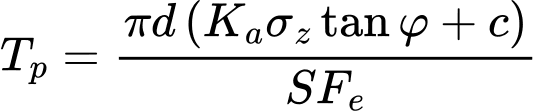
where:

where: | Tp | - | pull-out nail bearing capacity [kN/m] |
d | - | hole diameter | |
σz | - | vertical geostatic stress | |
φ | - | effective angle of internal friction of the soil | |
c | - | effective cohesion of the soil | |
SFe | - | factor of safety against pull-out |
3. calculate according to HA 68/94
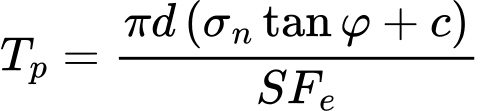
where: | Tp | - | pull-out nail bearing capacity [kN/m] |
d | - | hole diameter | |
σn | - | average radial effective stress | |
φ | - | effective angle of internal friction of the soil | |
c | - | effective cohesion of the soil | |
SFe | - | factor of safety against pull-out |
Average radial effective stress σn is calculated by the following formula:
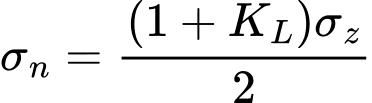
where: | σz | - | vertical geostatic stress |

where:

The nail head strength is evaluated by the formula:

where: | l | - | nail length |
Smax | - | maximum spacing of nails in a structure | |
Rt | - | nail strength against breaking | |
Tp | - | pull-out nail bearing capacity | |
SFf | - | factor of safety of a nail head strength |
If the nail is not anchored to the structure cover, it is possible to set the nail head strength to zero.
Literature:
FHWA0-IF-03-017