


Plane Slip Surface
Failure on the plane slip surface is manifested by a rock block sliding down along this surface. The rock wedge can be specified with a tension crack. The solution procedure of stability requires determination of the normal force N acting on the slip surface, the shear force Tact (active), and the resisting shear force Tres (passive).
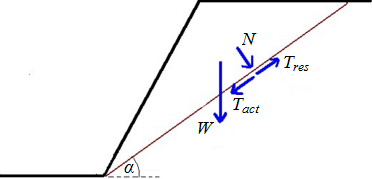 Forces on the slip surface
The shear strength parameters and the normal force N acting on the slip surface are the main input data for the determination of the resisting shear forces Tres. Calculation of the active shear force Tact and the normal force N is further influenced by the self-weight of block (depends on the geometry and unit weight of rock), anchorage, surcharge, influence of the water, and seismic effects. The active force Tact and the normal force N are determined as a sum of all forces entering the analysis.
The program offers several types of plane slip surfaces:
The resulting verification can be carried out either according to the selected verification methodology based on the input in the "Settings" frame.