


Rock Wedge
The program performs stability analysis of a rock wedge that is wedged in between two surfaces (planes) and slides in the direction of the line of interaction (tray) of these planes. The rock wedge can be specified with a tension crack. The gradient of this intersection must be considerably larger than the angle of internal friction dividing planes, whereas the falling line of both dividing planes must be directed towards the line of intersection. It is further assumed that the tray is located in a stable rock body.
The solution requires determination of the normal force N, the shear force Tact (active) and the resisting (passive) shear force Tres acting on slip surfaces A1 and A2. The active force Tact and the normal force N are obtained as a summation of all forces entering the analysis after performing the spatial resolution of these forces.
The Mohr-Coulomb shear strength parameters and the normal force N acting on the slip surface are the main input data for the determination of the resisting shear forces Tres. Calculation of the active shear force Tact and the normal force N is further influenced by the weight of the wedge (depends on the geometry of wedge and unit weight of rock), anchorage of the wedge, surcharge acting on the wedge, influence of water and seismic effects.
The resulting verification can be carried out according to the selected verification methodology based on the input in the "Settings" frame.
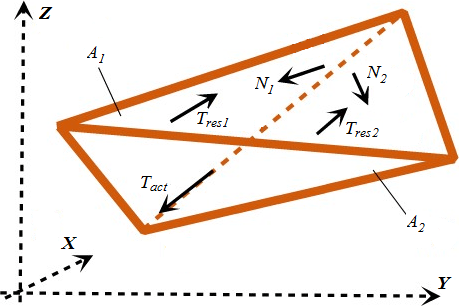 Components acting on a rock wedge