


Compression Index
It describes the variation of the void ratio e as a function of the change of effective stress σef plotted in the logarithmic scale:
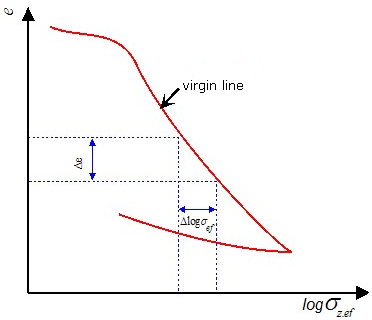 Void ratio e versus effective stress σef
It, therefore, represents a deformation characteristic of overconsolidated soil:

where: | Δe | - | variation of void ratio |
Δlogσef | - | variation of effective stress |
Range of compression index Cc (Naval Facilities Engineering Command Soil MechanicsDESIGN MANUAL 7.01)
A typical range of the compression index is from 0.1 to 10. Approximate values for homogeneous sand for the load range from 95 kPa to 3926 kPa attain the values from 0.05 to 0.06 for loose state and 0.02 to 0.03 for the dense state. For silts this value is 0.20.
For lightly overconsolidated clays and silts tested in USA Louisiana Kaufmann and Shermann (1964) present the following values:
Soil | Effective consolidation stress σcef [kPa] | Final effective stress in the soil σef [kPa] | Compression index Cc [-] |
CL soft clay | 160 | 200 | 0.34 |
CL hard clay | 170 | 250 | 0.44 |
ML silt of low plasticity | 230 | 350 | 0.16 |
CH clay of high plasticity | 280 | 350 | 0.84 |
CH soft clay with silt layers | 340 | 290 | 0.52 |
Prof. Juan M.Pestana-Nascimento (University of California, Berkeley) offers the following typical values of the compression index Cc:
Soil | Compression index Cc [-] |
Normal consolidated clays | 0.20 - 0.50 |
Chicago clay with silt (CL) | 0.15 - 0.30 |
Boston blue clay (CL) | 0.30 - 0.50 |
Vickburgs clay - dray falls into lumps (CH) | 0.3 - 0.6 |
Swedish clay (CL - CH) | 1 - 3 |
Canada clay from Leda (CL - CH) | 1 - 4 |
Mexico City clay (MH) | 7 - 10 |
Organic clays (OH) | 4 and more |
Peats (Pt) | 10 - 15 |
Organic silts and clayey silts (ML - MH) | 1.5 - 4.0 |
San Francisco sediments (CL) | 0.4 - 1.2 |
Clay in the old San Francisco Bay | 0.7 - 0.9 |
Bangkok clay (CH) | 0.4 |
In addition, there are empirical expressions available to determine approximate values of Cc for silts, clays and organic soils; their applicability, however, is more or less local:
Soil | Equations | Reference |
Transformed clays |
| Skempton 1944 |
Clays |
| Nishida 1956 |
Brazilian clays Sao Paulo clays |
| Cozzolino 1961 |
New York clays |
| Terzaghi a Peck 1948 |
Clays of low plasticity |
| Sowers 1970 |
Taipei clays and silts |
| Moh a kol. 1989 |
Clays |
| Pestana 1994 |