


Influence of Load History
The load history has a substantial influence on the distribution of the deformation curve and therefore also on the values of deformation characteristics. The following figure displays the deformation curve (Δe = f(Δσef) diagram) derived from oedometric loading test corresponding, e.g. to natural dense sandy soil.
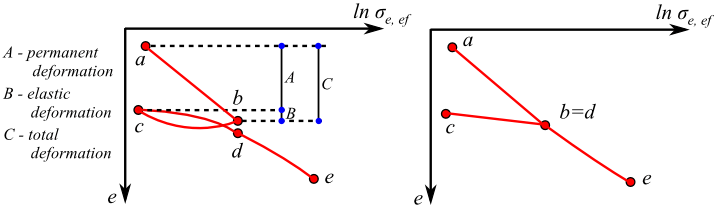 Load history a) Deformation curve for clayey soils from oedometric test b) Simplified interpretation of deformation curve
The soil sample was gradually loaded to reach the stress level σbef, the stress-strain relationship (σbef - ε) within the section a-b is linear and is denoted as primary or virgin (i.e., relative compression is encountered). Upon exceeding the stress level σbef the sample was elastically unloaded and the soil moved up the b-c section of the deformation curve. Upon reloading the soil moved down the b-c section till reaching the original stress σbef prior to unloading. When loading beyond σbef the deformation curve approaches asymptotically within the d-e section the primary line accompanied by inelastic deformation of a soil sample. Such a complex stress-strain curve is often simplified by the idealized deformation curve (fig. b). Such a curve characterizes so-called overconsolidated soils, which were in the past subjected large stresses and subsequently unloaded. The overconsolidation ratio (OCR) then represents the ratio between the maximum preconsolidation stress the soil has ever experienced and the current vertical stress. Overconsolidated soils typically follow the deformation curve given by points c-d-e. The change in slope along this line (given app. by point d) corresponds either to the vertical geostatic stress σo (normally consolidated soils) or to preconsolidation pressure σc (overconsolidated soils). This point influences the soil deformation, which is smaller within the c-d section when compared to the d-e section (where for the large degree of overconsolidation the soil deformation increases). Additional deformation characteristics such as deformation modulus upon unloading Ee, one-dimensional swelling index Ce, recompression index Cr, etc. were introduced to describe such a complex soil behavior. Currently the most often used parameter is the recompression index Cr suitable for the computation of settlement of overconsolidated soils.