


Load Combinations
Actions of loads that act simultaneously are introduced into the analysis with the help of load combinations defined in EN 1990 Basis of Structural Design. Most of the loads are considered permanent. Surcharges and input forces can be specified as a variable load. The program automatically determines the values of individual partial factors depending on whether the given load acts in favor or unfavorably.
By default, the variable loads are considered as major. Nevertheless, the "Verification" and "Dimensioning" frames allow specifying the variable loads as minor - such load is then multiplied by the corresponding coefficient reducing its magnitude. Providing that all loads are considered in the basic combination as minor, the program prompts a warning and the verification is not accepted.
Four types of combinations can be specified in the "Stage settings" frame:
Permanent and transient design situation:

where: | Gk,j | - | characteristic value of jth permanent load |
γG,j | - | partial factor of jth permanent load | |
Qk,i | - | characteristic value of a secondary ith variable load | |
Qk,1 | - | characteristic value of a primary variable load | |
γQ,i | - | partial factor of ith variable load | |
ψ0 | - | factor for the combination value of a variable load |
Accidental and seismic design situation:

where: | Gk,j | - | characteristic value of jth permanent load |
Qk,1 | - | characteristic value of primary variable load | |
ψ1,i | - | factor for frequent value of variable load | |
ψ2,i | - | factor for quasi-permanent value of variable load | |
Ad | - | design value of an extreme load |
Seismic design situation:

where: | Gk,j | - | characteristic value of jth permanent load |
Qk,i | - | characteristic value of secondary jth variable load | |
ψ2,i | - | factor for quasi-permanent value of variable load | |
AEd | - | design value of a seismic load |
Load partial factors and combination coefficients are introduced in the "Partial factors" dialog window.
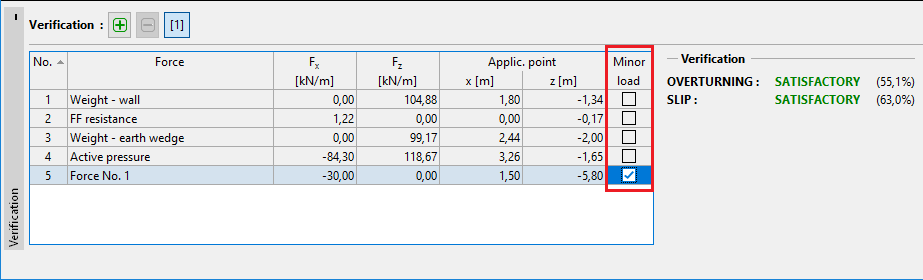 Input of minor loads